



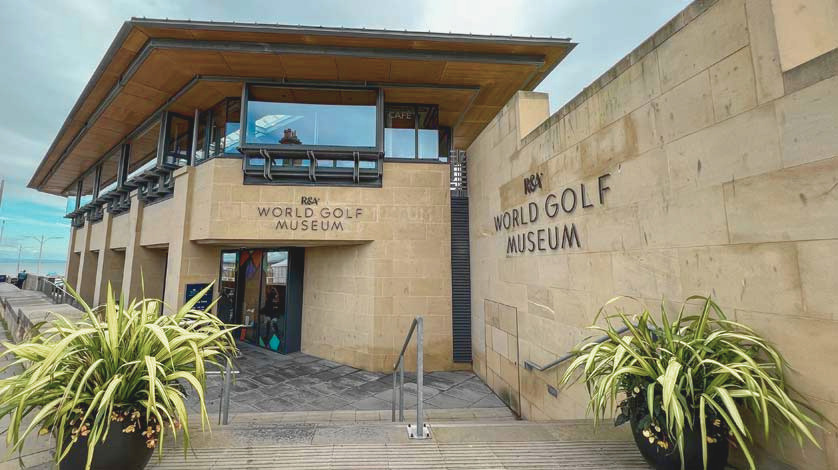
Set into the embankment beside the first tee of the Old Course, the R&A’s museum tells the story of golf from a medieval pastime to a global game — and does it well enough that the person who came along under protest usually stays longest.
The first thing to understand about the R&A World Golf Museum is where it is. Walk out of the front door, cross the road, and you are standing beside the first tee of the Old Course, with the grey stone clubhouse of the Royal and Ancient Golf Club on your left and the West Sands running away to the north. The museum is set low into the Bruce Embankment, roofed in grass, so as not to interrupt anyone’s view of any of that. It is, in other words, a museum about golf built on the one piece of ground in the world where the subject needs no introduction, and it has the good manners not to compete with it.
Inside, the story runs for something over four hundred years: from the game the Scots were playing on this stretch of coast in the 1500s, when a king tried to ban it because it was distracting his archers, through the featherie balls and long-nosed clubs of the club-makers who lived on the streets behind you, to the Opens and Ryder Cups of the television age. It takes an hour if you are dutiful and two if you are the sort of person who reads every card, and there is a café upstairs with a view over the course and the beach for whichever of those you turn out to be.
Why go
Because it is the collection. The R&A began gathering golfing relics in the nineteenth century, when the club’s members realised that the balls and clubs they were throwing out were already antiques, and what started as a cabinet of curiosities in the clubhouse is now the most significant collection of golf’s material history anywhere. Some of the oldest clubs in existence are here, hand-made from thorn and ash. There are featheries — leather balls stuffed with a top-hat’s worth of boiled goose feathers, stitched and hammered by men like Allan Robertson, who lived on the street behind the museum and was, by common agreement, the first golf professional. There is the driver Walter Hagen used to win the Open in 1929, the pocket watch that belonged to Jim Barnes, who won it in 1925, and the gold medal King William IV presented to the club in the 1830s, which is the reason it is called the Royal and Ancient at all.
The other reason is that since 2021 it has been a very good museum rather than merely an important one. For thirty years it was the British Golf Museum, worthy and slightly dim. After an eighteen-month closure it reopened as the R&A World Golf Museum with the galleries rebuilt into six thematic zones, the lighting fixed, the films remade, and enough to touch, swing and putt that a ten-year-old will not ask to leave.
What you will see
The galleries run chronologically, more or less, and the pleasure is in the objects rather than the panels. Early on there is a tile from the Low Countries showing figures with sticks and a ball, entered into the long argument about whether the Dutch or the Scots got there first; the Scots, this being St Andrews, win. Then the clubs and balls of the eighteenth and nineteenth centuries, when St Andrews and Musselburgh made most of the world’s golfing equipment by hand, and the portraits and medals of the men who played with it — Old Tom Morris, who laid out the Old Course as you see it today and is buried in the cathedral grounds fifteen minutes’ walk away, and his son Young Tom, who won four Opens in a row and was dead at twenty-four.
The twentieth century brings the Americans, the professionals, the money and the fashion: a case of golf clothing that runs from tweed plus-fours to something worn at a recent Open that will make you wince; a railway poster from the 1920s selling St Andrews to Londoners as a golfing resort; the great trophies and the players who lifted them. Throughout there are things to do. You can set your grip against a champion’s on a cast club, putt with a hickory-shafted replica on an indoor green, and, in the Learning Room, let children dress up as an Edwardian golfer while you sit down for five minutes.
“A museum about golf built on the one piece of ground in the world where the subject needs no introduction.”
The detail people remember
The café. It sits above the galleries, and its windows look out over the first and eighteenth fairways, the clubhouse, and the whole sweep of the West Sands to the Eden estuary. On a bright morning it is one of the best places in town to sit with a coffee and watch the first groups go off, and unlike the clubhouse opposite, anyone can walk in. Golfers in the know use it as their waiting room before a tee time; non-golfers use it as their reward.
Who it is for
The golfer who has come to St Andrews on pilgrimage and wants the story behind the ground they are about to walk. The partner who has not, and who will find it more absorbing than they expected. Families on a wet afternoon — under-sixteens go free and the Learning Room is designed for them. Anyone with an hour to fill before a tee time on the Old, the New or the Jubilee, all of which start within two hundred yards of the door.
It is not a large museum, and it does not pretend to be. If you are looking for a whole day out, pair it with the Old Course itself on a Sunday, when the course is closed to play and open to walkers, or with the aquarium two minutes along the Scores if you have children in tow. The adult ticket is not cheap for the size of the place; the collection justifies it, but go in knowing that.
A little history
The R&A’s collection grew informally through the nineteenth century, kept in the clubhouse and shown to members and their guests. It first had a purpose-built home in 1990, when the British Golf Museum opened in this building on the embankment, deliberately sunk into the ground so that the view from the clubhouse windows over the course and the sea would not change. In early 2020 it closed for a complete redisplay, reopening on 21 June 2021 under its present name, with the R&A’s own heritage team having reimagined the galleries around the idea that golf is now a world game whose story happens to begin here.
What to do nearby
• The first tee of the Old Course, across the road; on Sundays walk the whole course, Swilcan Bridge included. Read: St Andrews Links, more than the home of golf.
• The West Sands, starting at the foot of the embankment; two miles of beach, best at low tide.
• St Andrews Aquarium, two minutes’ walk along the Scores, for the children.
• St Andrews Castle, five minutes along the clifftop, with its bottle dungeon and mine and counter-mine.
• Old Tom Morris’s grave in the cathedral grounds, fifteen minutes on foot through the town. Read: St Andrews Cathedral, where the story began.
|
Know before you go |
|
|
ADDRESS |
Bruce Embankment, St Andrews, Fife KY16 9AB — directly opposite the R&A clubhouse and the first tee. Tel 01334 460046. |
|
FROM THE OLD COURSE |
You are beside it: the first tee is across the road, the eighteenth green a minute’s walk. Market Street is eight minutes on foot. |
|
HOURS / SEASON |
Open daily, all year. Roughly 9.30am to 5pm in winter, longer in summer; the café keeps its own, shorter hours. Check before you go, and expect changes during Open week in July 2027. |
|
PRICE |
Adults £17.50; over-65s £12.50; students £7.50; under-16s and carers free. A small discount for booking online in advance. |
|
HOW TO BOOK |
Book a timed ticket at worldgolfmuseum.com, or walk in; only on peak summer days and during tournaments do you need to plan ahead. |
|
GOOD TO KNOW |
Allow one to two hours. Step-free throughout, with sensory bags and a sensory map for visitors who need them. A free digital guide runs on your own phone. No car park of its own — use the Bruce Embankment or West Sands car parks, both a minute away. The R&A shop is inside. |
|
BEST TIME |
Any wet afternoon, or the hour before an early tee time, when the café upstairs doubles as the best-placed waiting room in golf. |
Share:
Inside Eden Mill: St Andrews’ New Home of Gin and Whisky
The Kartel Watch Experience, St Andrews: an afternoon in the workshop, and a watch to show for it