



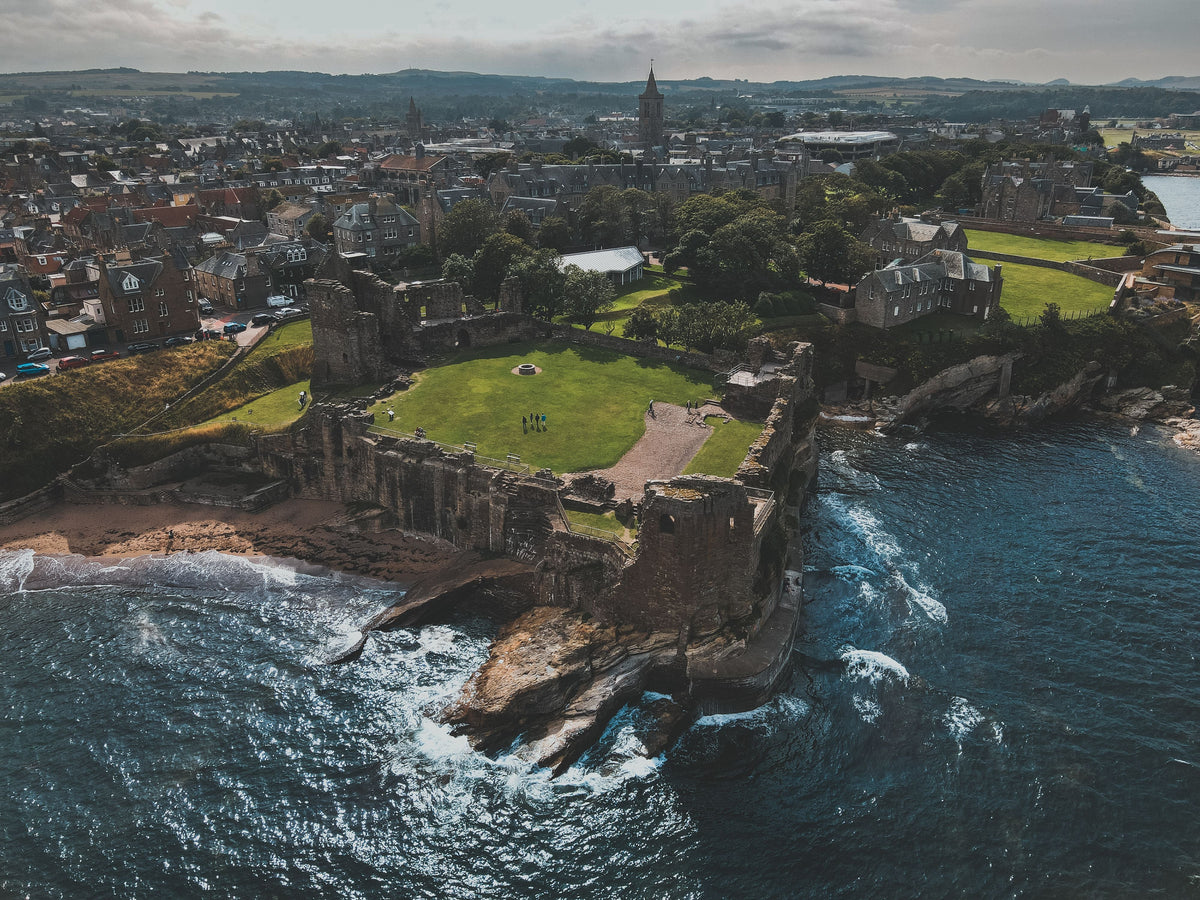
Before golf, there were pilgrims
Stand among the ruins of St Andrews Cathedral and it's difficult not to wonder what this place must once have looked like.
Today there are fragments: great stone walls, arches open to the sky, weathered gravestones and St Rule's Tower rising above them.
But this was once the largest church in Scotland.
For centuries, St Andrews was one of medieval Scotland's most important religious centers — a destination for pilgrims who travelled here to worship at the shrine associated with St Andrew, Scotland's patron saint.
Long before people crossed oceans to play the Old Course, they were making another kind of pilgrimage to St Andrews.
And in many ways, this is where the story of the town begins.

Scotland's greatest cathedral
A Celtic monastery existed on this site from at least the 8th century.
Construction of the great cathedral began around 1160 under Bishop Arnold. What followed was an extraordinary building project stretching across more than 150 years, interrupted by everything from a great storm in 1272 to the Wars of Independence.
The cathedral was finally dedicated in 1318, with Robert the Bruce in attendance.
At its height, it was by far the largest church in Scotland and the headquarters of the medieval Scottish Church — the seat of the country's leading bishops and archbishops.
Knowing that changes the experience of walking through the ruins.
Look beyond what's still standing and try to imagine the scale of what has disappeared.

The tower that came first
One structure predates the cathedral itself.
St Rule's Tower rises 33 meters above the grounds and formed part of an earlier church built here in the 12th century.
Tradition tells us that St Rule — or St Regulus — brought relics of St Andrew from Patras in modern-day Greece, eventually reaching the coast of Fife and establishing a church here. The tower may later have acted as a beacon for pilgrims approaching St Andrews.
When access is available, climb it.
The reward is one of the great views of St Andrews: across the cathedral ruins, over the rooftops of the town and towards the coastline beyond.
It's also one of the best places to understand the geography of St Andrews.
From up here, centuries of the town's history suddenly sit together.
Then everything changed
The cathedral's power did not last forever.
The Scottish Reformation transformed the religious landscape of the country during the 16th century, and the cathedral was eventually abandoned as a place of Catholic worship.
What had taken generations to build gradually became the extraordinary ruin we see today.
But that ruin has arguably become part of the beauty of the place.
There is no reconstructed medieval interior or attempt to disguise the passing of time.
Instead, enormous sections of stonework stand alone against the North Sea sky.
On a quiet morning — particularly when the weather turns suitably Scottish — it can be one of the most atmospheric places in town.

Look for some very famous golfers
There's another connection here that visitors sometimes miss.
Among the cathedral's historic graves are two names fundamental to the story of golf.
Old Tom Morris and Young Tom Morris are buried here.
Old Tom helped shape golf as we know it, winning The Open four times and becoming one of the most influential figures in the development of the game and its courses.
His son, Young Tom, became golf's first great young superstar.
Nearby you'll also find the grave of Allan Robertson, another pioneering St Andrews golfer and one of the greatest players of the era before The Open Championship existed.
For golfers, it's worth seeking them out.
It connects two completely different eras of St Andrews: the ancient destination of pilgrimage and the town that would eventually become the world's destination for golf.
Don't rush it
You could walk through the cathedral grounds quickly.
We wouldn't.
Give yourself time to wander.
Walk beneath the surviving arches. Look at the inscriptions on the old gravestones. Find the Morris graves. Stand beneath St Rule's Tower. Walk towards the eastern edge of the grounds where the land begins to meet the sea.
Then continue towards the harbor.
St Andrews Cathedral is particularly good as part of a longer walk through the historic eastern end of town — taking in the harbor, the university and nearby St Andrews Castle.
It's one of those occasions where getting slightly lost is probably preferable to following Google Maps.
Who is St Andrews Cathedral for?
First-time visitors
If you want to understand why St Andrews exists where it does, start here.
History lovers
The cathedral sits at the center of centuries of Scottish religious and political history.
Golfers
Come to find Old Tom Morris, Young Tom Morris and Allan Robertson — and discover the St Andrews that existed long before golf made it famous.
Photographers
Ruined medieval architecture, ancient gravestones, changing North Sea light and enormous skies make this one of the most photogenic places in town.
Families
There's space to explore, stories to discover and a tower that makes history considerably more interesting than reading another information board.
Know before you go
Where: The Pends, St Andrews, Fife, KY16 9QL.
Entry: The cathedral grounds are currently free to enter.
St Rule's Tower: Guided tours are currently available with an opportunity to climb the tower, subject to availability.
Important: Conservation work is currently taking place. The museum and shop are closed and some sections of the graveyard are fenced because of unstable gravestones, so check current access before visiting.
Good for: History, photography, families, golfers, architecture and first-time visitors.
Visit St Andrews view
The Old Course explains why millions know St Andrews today. The Cathedral helps explain why St Andrews was important in the first place.
Share:
25 Amazing Things to Do in St Andrews, Scotland
Inside Eden Mill: St Andrews’ New Home of Gin and Whisky