



Stand on the first tee of the Old Course and you're not simply looking down a fairway. You're looking across more than six centuries of golfing history.
By Visit St Andrews
There are few places in sport where the setting matters quite as much as the game itself.
At St Andrews, golf doesn't sit apart from the town. It runs through it.
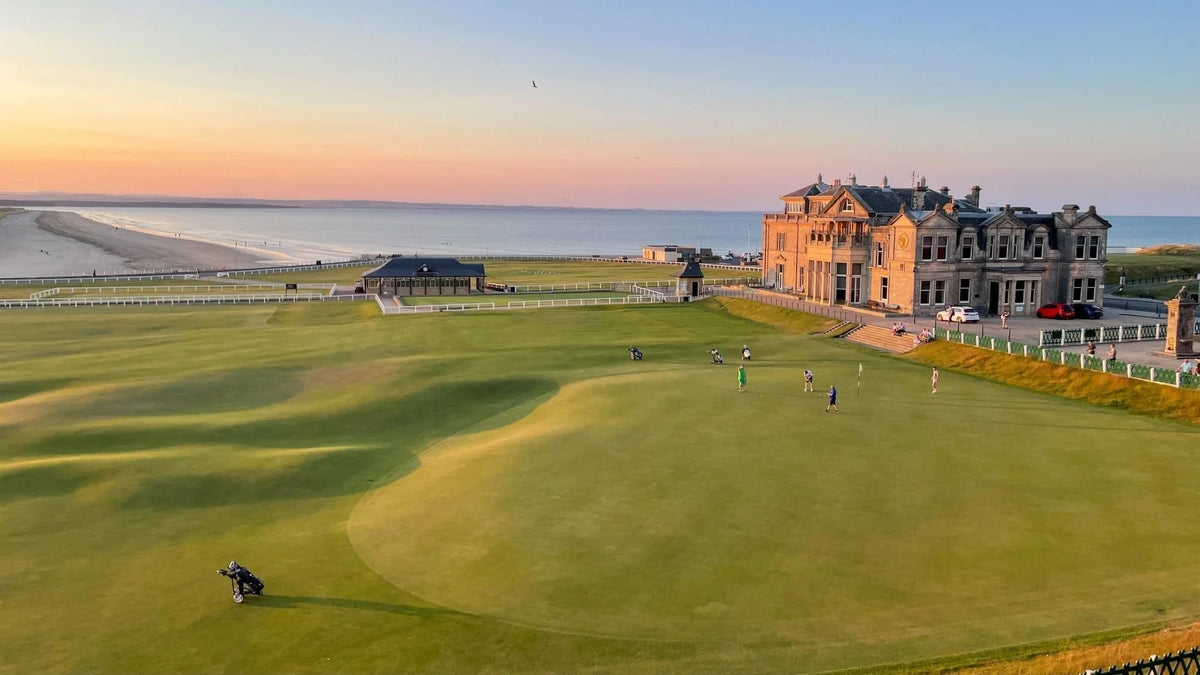
The 18th fairway ends almost on the edge of the streets. The Royal and Ancient clubhouse looks across the first tee. Beyond the course, the North Sea meets the great sweep of West Sands. Students cross paths with golfers carrying their clubs through town, while visitors stop beside the famous stone bridge they have seen countless times on television.
This is the Old Course at St Andrews.
And for golfers around the world, there is nowhere quite like it.
A course shaped by centuries
The Old Course wasn't designed in the modern sense.
It evolved.
Golf has been played on the links at St Andrews for more than 600 years, across land shaped by wind, sea and generations of golfers.
That history gives the course something impossible to manufacture.
Fairways are shared. Greens are enormous. Bunkers have names and reputations of their own. Shots that initially appear straightforward reveal possibilities that generations of players have spent lifetimes understanding.
It is a golf course that rewards imagination as much as precision.
And remarkably, many of the characteristics that once emerged naturally from the landscape went on to influence golf-course design around the world.


The first tee
There is something wonderfully understated about arriving at the first tee.
No enormous stadium surrounds it.
Instead, there is St Andrews.
The clubhouse behind you. Hamilton Grand across the road. The town beyond. The wide expanse of the links stretching ahead.
For somebody who has spent years watching the Open Championship, the surroundings are immediately recognizable.
Then comes the strange part.
You actually have to hit the ball.
The opening fairway is extraordinarily wide, but standing over that first shot can make it feel considerably narrower.
That's St Andrews.
History has a habit of getting into your head.
The bridge everyone knows
Walk toward the final hole and one of golf's most recognizable landmarks appears.
The Swilcan Bridge is tiny.
That's perhaps the first surprise.
Its stone arch crosses the Swilcan Burn between the first and 18th fairways, and generations of the world's greatest golfers have walked across it.
Jack Nicklaus famously stopped here during his final competitive round at St Andrews in 2005.
Others have followed.
For many golfers, standing on the bridge has become almost as important as playing the hole itself.
But visit early in the morning, before the crowds arrive, and it becomes something different.
A small stone bridge.
An ancient golf course.
The town waking up behind it.
That's when you begin to understand why this place has such a hold over people.


The Road Hole
Then there is the 17th.
The Road Hole.
One of the most famous holes in golf begins with one of its strangest tee shots: across part of the Old Course Hotel.
The hotel wasn't there when golfers first began playing this ground, of course, but today its presence is inseparable from the hole.
Find the fairway and the problem isn't over.
The Road Hole bunker guards the approach. A stone wall and road sit beyond the green.
It is awkward, intimidating and completely unforgettable.
And that is part of the charm of the Old Course.
It doesn't always behave like a modern golf course.
Nor should it.
More than a golf course
Perhaps the greatest thing about the Old Course is that it remains part of everyday St Andrews.
There are no gates separating it from the town.
People walk beside it.
Dogs are exercised around the links.
On Sundays, when the Old Course is generally closed to golf, the famous fairways become a public space again.
That relationship between town and course is fundamental to understanding St Andrews.
Golf isn't an attraction that was added here.
Golf belongs here.
Sunday on the Old Course
If you're visiting St Andrews and aren't playing, Sunday can be one of the best times to experience it.
With regular play traditionally absent, you can walk across parts of the course that you've watched professionals navigate during the Open.
Stand beside bunkers.
Cross the fairways.
Walk toward the Swilcan Bridge.
Look back toward the Royal and Ancient clubhouse.
And then continue toward West Sands.
You don't need a tee time.
You don't even need to play golf.
It's simply one of the great walks in St Andrews.
When the Open comes home
Every few years, St Andrews changes.
Grandstands rise around the Old Course. The world's best players arrive. Thousands pour into the town.
And the Open Championship returns to the place most closely associated with its history.
In July 2027, the championship returns again, when St Andrews hosts the 155th Open.
For one week, this small Scottish town will once again become the center of the golfing world.
But the real beauty of St Andrews is what happens when everyone leaves.
The grandstands disappear.
The links return to normal.
And the Old Course continues doing what it has done for centuries.
Hosting golf.
If you go
I'd finish each Visit St Andrews journal with a very clean Need to Know box.
Best for
Golf history, walking, photography and experiencing the atmosphere of the Home of Golf.
Don't miss
The Swilcan Bridge, 17th Road Hole, 18th green and a walk along West Sands.
Best time to visit
Early morning for atmosphere and photography. Sunday is particularly special for visitors wanting to experience the course on foot.
Allow
Around 90 minutes for a relaxed walk around the key landmarks.
Nearby
West Sands · British Golf Museum · St Andrews town center · St Andrews Harbour
Share:
The Open Returns Home: St Andrews 2027